
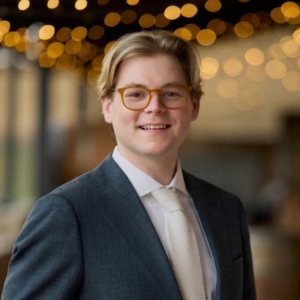
Owen Lednor is General Manager of The Shoreline, an integrated provider of residential aged care, retirement living and community care services in Coffs Harbour, NSW. Holding a Master of Nursing (Leadership and Management), Owen has worked across clinical care, quality, education, strategy, business development and executive leadership within the aged care sector.
Owen played a key role in commissioning The Shoreline’s residential aged care and retirement living development and has since helped guide the organisation through significant growth, reform and transformation. His work spans governance, workforce development, digital transformation, artificial intelligence and service innovation, with a strong focus on balancing innovation with genuine community connection.
Passionate about the future of ageing services, Owen believes regional organisations are uniquely positioned to challenge traditional assumptions and create new models of care, connection and community for older Australians.
From Shopping Centres to Ageing Services: How an Outsider Perspective Sparked Innovation in Regional Aged Care
“Problems mean progress”
For decades, our organisation developed and operated shopping centres, commercial property and communities across Australia. When we entered aged care, we expected to learn a new industry. To prepare, we toured more than 30 aged care homes across Australia, studied established models and sought to understand the many complexities of the sector.
What we did not expect was how often we would find ourselves asking a simple question – Why?
Why are services designed this way?
Why are these systems separated?
Why do we accept certain challenges as unavoidable?
Why are some assumptions rarely questioned?
Without a long history in the sector, we approached aged care from a different perspective. Rather than asking how to fit into existing models, we asked why those models existed in the first place.
That mindset led us to challenge traditional boundaries between residential aged care, retirement living and community care; rethink the role of technology in human-centred services; adopt hospitality principles from outside the sector; and create new approaches to leadership, workforce development and organisational culture.
Some ideas succeeded immediately.
Others failed.
Others created problems we had not anticipated.
And that became one of our most important lessons.
“Problems often mean progress.”
If innovation only produces comfortable outcomes, it is unlikely to be innovation at all. Real transformation creates friction. It exposes weaknesses, challenges assumptions and forces organisations to learn.
This presentation explores how a regional provider used an outsider’s perspective to drive innovation across multiple areas of service delivery. Practical examples include the integration of traditionally separate service streams, the application of digital transformation and artificial intelligence to support workforce capability and consumer outcomes, the adoption of hospitality and customer experience principles to influence service design, and the deliberate creation of organisational cultures that encourage experimentation while maintaining strong governance and compliance.
Importantly, this is not a presentation about a single project, technology platform or service initiative.
It is an exploration of how innovation becomes possible when organisations intentionally create cultures that encourage curiosity, challenge inherited thinking and remain open to ideas from beyond their own sector.
It is also a story about leadership. While many organisations seek certainty before acting, our experience suggests innovation often emerges when leaders create environments where questions are valued as highly as answers. Some of our most successful initiatives began as ideas that initially appeared unrealistic, impractical or simply different from accepted industry practice.
As aged care providers navigate reform, workforce pressures, financial constraints and increasing consumer expectations, many organisations are searching for sustainable ways to improve outcomes. Our experience suggests that some of the most valuable innovations may not come from new products or systems, but from the willingness to challenge assumptions that others no longer notice.
Delegates will leave with practical insights into fostering cultures of innovation, balancing creativity with compliance, adapting ideas from outside aged care, and creating environments where new approaches can be tested, refined and embedded into everyday practice.
Ultimately, this is not a story about a property business entering aged care.
It is a story about what becomes possible when organisations stop asking how to improve existing models and start asking whether entirely different models are possible.